
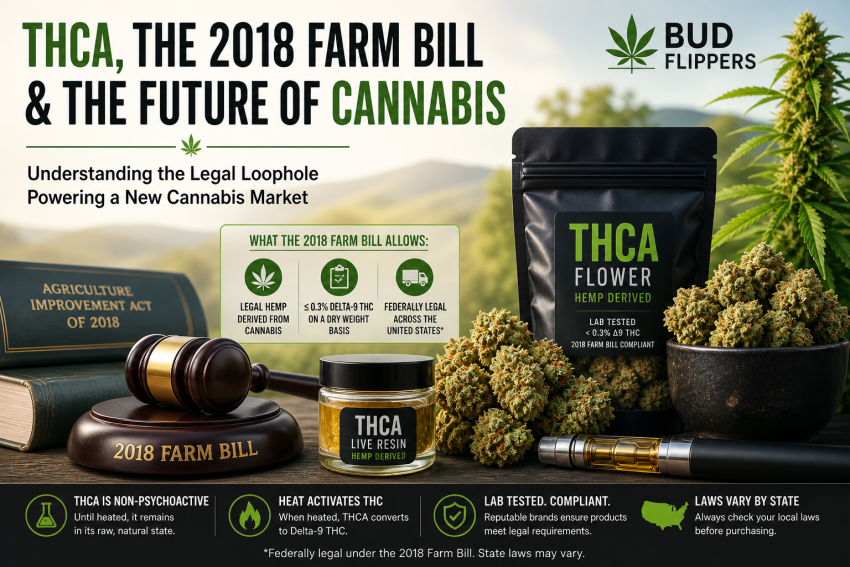
In recent years, a new segment of the cannabis industry has emerged in the United States—one built not on traditional marijuana laws, but on a technical legal distinction created by the 2018 Farm Bill. At the center of this shift is THCA (tetrahydrocannabinolic acid), a compound that has rapidly gained popularity across online marketplaces like BudFlippers.
Understanding this space requires unpacking both the science of THCA and the legal framework that made its sale possible.
What Is THCA?
THCA is the raw, non-psychoactive precursor to THC, naturally found in cannabis plants. In its original form, THCA does not produce the “high” associated with cannabis. However, when exposed to heat—through smoking, vaping, or cooking—it undergoes a process called decarboxylation, converting into delta-9 THC.
This unique characteristic is what places THCA in a legal and commercial grey zone. On paper, it is non-intoxicating. In practice, it can become psychoactive when used.
The 2018 Farm Bill: The Legal Foundation
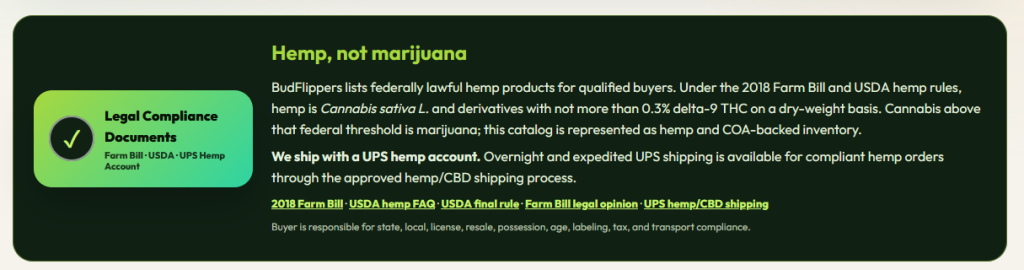
The Agriculture Improvement Act of 2018 (Farm Bill) fundamentally reshaped the cannabis industry in the United States. It legalized hemp and all its derivatives, provided they contain no more than 0.3% delta-9 THC by dry weight.
Here’s the key detail:
👉 The law specifically measures delta-9 THC—not THCA.
Because THCA is not delta-9 THC in its raw form, hemp products can legally contain high levels of THCA while still complying with federal law—as long as delta-9 THC remains below the 0.3% threshold.
This distinction effectively created what many in the industry refer to as the “THCA loophole.”
The Rise of THCA Products & Online Platforms
This legal nuance has given rise to a booming market of THCA-rich hemp products, including:
- THCA flower
- Pre-rolls
- Concentrates and vapes
- Edibles infused with hemp-derived cannabinoids
Online platforms like BudFlippers operate within this ecosystem, offering access to these products through digital storefronts. These marketplaces typically emphasize:
- Hemp-derived sourcing
- Lab-tested compliance (delta-9 THC below 0.3%)
- Nationwide shipping (where permitted)
The appeal is clear: consumers in states without full cannabis legalization can access products chemically similar to traditional cannabis, but marketed under federal hemp laws.
Why THCA Exists in a Legal Grey Area
Despite its federal status, THCA is far from universally accepted. The legal situation is complex for several reasons:
⚖️ 1. Federal vs State Law
While THCA may be federally compliant under the Farm Bill, individual states can impose stricter rules. Some states have already banned or restricted THCA products outright.
🔬 2. Conversion to THC
Regulators argue that because THCA converts into THC when heated, it should be treated similarly to cannabis. This has led to increasing scrutiny from agencies and lawmakers.
📦 3. Enforcement Challenges
The distinction between hemp and marijuana often comes down to lab testing and timing, making enforcement inconsistent across jurisdictions.
The 2026 Shift: Closing the Loophole
The current legal framework may not last much longer.
New federal changes expected to take effect in November 2026 will redefine hemp to include “total THC”, which counts THCA alongside delta-9 THC.
If implemented fully, this would:
- Eliminate most high-THCA hemp products from legal sale
- Reshape the online hemp marketplace
- Bring THCA products closer to traditional cannabis regulation
In short, the legal window that enabled platforms like BudFlippers may narrow significantly.
Consumer Considerations
For consumers exploring THCA products online, it’s important to keep a few things in mind:
- Legality varies by state, even if products are federally compliant
- THCA products can still produce psychoactive effects when heated
- Quality and safety depend on lab testing and reputable sourcing
- Laws are evolving rapidly—what’s legal today may change tomorrow
Final Thoughts
The emergence of THCA highlights how science, law, and commerce intersect in the modern cannabis industry. Platforms like BudFlippers represent a new wave of digital cannabis access—built on innovation, but also shaped by regulatory uncertainty.
The 2018 Farm Bill didn’t intend to legalize intoxicating cannabis nationwide—but by focusing solely on delta-9 THC, it created a pathway that entrepreneurs quickly embraced.
As regulations tighten and definitions evolve, the future of THCA will depend on how lawmakers balance consumer access, safety, and market control.
2 thoughts on “THCA, the 2018 Farm Bill & the Rise of Online Hemp Markets”
Comments are closed.